


Against all odds: Molomo makes it in bean seed production
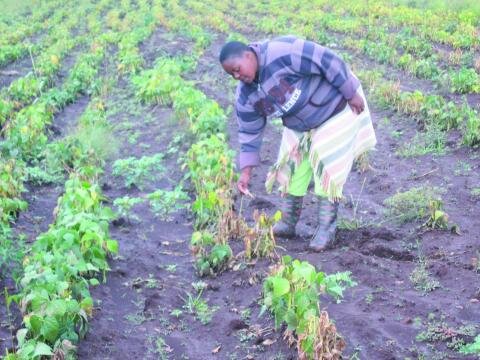
MAFETENG- Standing in the middle of her farm under a scorching sun, ‘Malikhetho Molomo, an avid farmer, projects a promising harvest for her bean plantation despite the Elnino –induced drought which struck the country late last year and into 2016, leaving most farming areas derelict.
Molomo, a young farmer who specialises in bean seed production says she has more than five years in the sector which is not liked by most women of her age.
She says since she ventured into this enterprise, her life has changed significantly and has achieved what seemed impossible to those around her.
Telling her story to Informative, this enterprising farmer living at Ribaneng in the Mafeteng district says she used to plough like any other ordinary Mosotho woman living in the rural areas whose source of income is subsistence farming while oblivious of the fact that she is doing a wonderful job.
“It was only when agricultural extension officers from the Ministry of Agriculture and Food Security (MAFS) approached me to plough a certain type of beans when l realised that l am doing a good job,” Molomo told Informative.
This smallholder farmer was quick to mention that the growing importance of women in food production and food security goes unnoticed in the country.
She says MAFS, through its Department of Research, maintained a close surveillance to her farming techniques which made her resilient to the challenges brought in by poor harvests induced by successive droughts.
Upon MAFS realisation of her commitment towards food production, Molomo was incorporated into a training programme to hone her skills and to further equip her with necessary skills to realise her big dream, that of being a commercial farmer.
After the training, her passion for food security grew bigger and she now realises that farming is not for the uneducated as most people mistakenly believe so.
“We have to dispel this perception as it will hold the country back in terms of food production,” declares the farmer. “Women have to roll up their sleeves and ensure that they are in the driver’s seat when it comes to food production in their households.”
However, she reveals that Lesotho’s rural-based subsistence farmers are facing a myriad of challenges which include but not limited to hybrids and climate smart agricultural knowledge and skills.
“The training courses that I underwent,” she explained, “have helped me to know the farming techniques in a scientific way because given the vicissitudes of weather these days. I now know what type of seeds to plant and when to do so in order to realise good harvests.”
“I have to start ploughing my bean seeds in September every year and thereafter always be after my crops to take care of them in every single day.”
At the same time, she says, MAFS introduced her to the Seeds and Markets Project (SAMP) company that has helped the ministry a great deal in terms of training on how to select the quality seed from the harvest, packet it and hunt for the buyers who are mostly the local farmers.
She maintains that SAMP also solicits loans for them to buy farming inputs and pay later when they have harvested and sold their produce. Molomo is currently reaping the rewards of supplying seeds to the local farmers with the help of SAMP.
The young farmer also reiterates that MAFS has also introduced Food and Agricultural Organisation (FAO) to them with farming subsidies such as hybrids, insecticides and fertilisers.
“I sell the seeds to the local farmers and there is profit generated from this initiative. I have been paying my two children’s tuition fees through the sale of bean seeds,” she said.
“I am also taking care of my household needs with the revenue that l generate from the bean seed,” added the farmer.
During good harvests, she is able to temporarily employ about 25 people in her area and pay them on a daily basis.
Asked if she has set any discernible influence in her area, Molomo says some women of her age usually get fascinated about her job and in turn, she usually refers them to MAFS for further assistance.
Molomo remains firm that while most women farmers in the rural areas of the country have similar reasons to feel discouraged to make food security a national concern and do something about it, there is a lack of public policies recognising them and addressing the challenge.
The recent past Elnino-induced drought has left many Basotho subsistence farmers’ silos empty and Basotho are facing a sure poverty since they are not going to harvest anything this winter. But, Molomo is not one of them.