


Breaking Free of Poverty Clutches
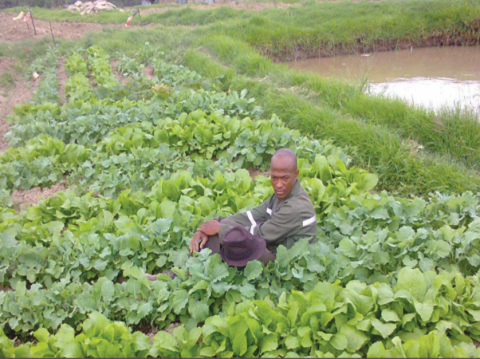
Maseru - Driven by an insatiable desire to transform the mind-set of the youth who mistakenly believe agriculture is meant for those from underprivileged and economically challenged backgrounds, Ramahlele Keketso, 29, has a good story to share. Keketso, who is a qualified teacher staying at Mazenod, on the outskirts of the city of Maseru in Lesotho, says he was motivated to venture into commercial agriculture by a friend who works at a big supermarket who told him there was life out of selling agricultural produce.
“The friend told me that there is a market for agricultural products. I had no time to waste but to roll up my sleeves and produce vegetables for the already existing market,” Keketso quipped at his small farm recently.
Unlike other successful farmers, he only ventured into the sector in 2015 when the country and the whole of southern Africa were facing a surmountable drought that came as a result of the El Nino effect that saw many Basotho farmers unable to utilise their land for agricultural purposes and trapped them in abject poverty.
“I simply had to till my land and sow my seeds and watered it only at night with the scarce water that l drew from a nearby dam, which unfortunately went dry before my vegetable crop could mature.”
Keketso also explains that his plants survived the severe weather after he added cow dung as manure to enrich the soil. He says he earns a lot of revenue when he sells his produce to major supermarkets than when he sells to individuals from his plot.
The determined young farmer maintains that he has a big dream that he is set to achieve - that of owning a big farm to fulfil his farming desires. He further advises that Lesotho stands a better chance to produce quality potatoes because of the high altitudes and good weather, when the country is not struck by drought such as the one currently prevailing. He insists that without involving youth in the implementation of the Sustainable Development Goals (SDGs), the achievement of the set goals would be practicably impossible by 2030.
Keketso maintains that agriculture is the way to go in order to curb the disturbing levels of youth unemployment which currently stands at 40 percent.
“For the youth who had already thrown their toys out of the cot when it comes to agriculture, I urge them to claw their way back into the sector to find their light,” he says.
What Keketso is doing is in line with the Comprehensive Africa’s Agricultural Development Programme (CAADP), a programme under the NEPAD Agency that advocates for youth to be involved in food production initiatives.
The 2003 Maputo Declaration under which CAADP and itsprinciples were adopted, was reaffirmed in the 2014 Malabo Declaration, at the 23rd African Union Summit of Heads of State and Government in Equatorial Guinea. They agreed to targets such as doubling agricultural productivity, halving post-harvest loss, and bringing stunting down to 10 percent across Africa by 2025.
The Malabo Declaration seeks to ensure proper coordination of existing agricultural and youth programmes run by different stakeholders in order to help the eradication of unemployment amongst youth through agriculture.