


Taking the Reigns in the Fisheries Industry
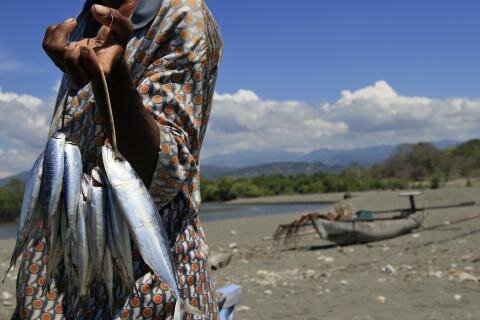
Twenty million hectors of land in Zambia is covered in water. This can be taken as evidence of the country’s potential for investment in irrigation and the fisheries industry. In continued efforts to enhance agricultural diversification, the Zambian government recently obtained a US$50 million loan from the African Development Bank to boost fish production.
Given the environment that the Government is trying to create in the fisheries sector, Dr Faustin Mwape is one individual who has taken up the challenge to invest in aquaculture. He has designed an affordable fish net that will be financially accessible to small scale farmers. Currently, most fish cages on the market are big and hence fairly expensive for the average Zambian farmer to purchase.
Dr. Mwape’s innovation, on the other hand, is not new per se, but it is simply aimed at making aquaculture affordable through a significant smaller than ordinary floating fish cage, which he is producing under the brand name Scadoxus.
“We’re giving you approximately one cubic metres of space and in that you can accommodate 350 breams in the natural water bodies as long as you have 1.5m of water depth,” Dr Mwape said.
He explained that using the Scadoxus floating fish cage, if a fisher stocks his/her cage with 60g of fingerlings, they would be able to get out 150g of fish. This will all be attainable at only K6,000 - the current cost of the floating fish cage which, has the capacity of catching 3,500 breams. A perfect example of low investment with high returns.
The Scadoxus floating fish cage is also designed to protect a farmer’s fingerlings and fish from crocodiles – a concern that has been raised by some farmers who are interested in aquaculture. At a slightly higher cost of only K50, Scadoxus Limited is able to provide a form wire protection around the fish cage. However, this type of protection can even be done farmers themselves.
Dr Fausin Mwape is an agricultural specialist with a reputable background as a lecturer, a consultant and now emerging farmer. He is currently based in Solwezi in the North-Western Province of Zambia in which he is actively involved in horticulture, poultry and aquaculture.
He laments that the biggest challenge that the fisheries industry is still facing is the shortage of fingerlings. He added that the cage that he has designed will also be effective in the production of fingerlings.
However, a critical obstacle that farers like himself are facing in aquaculture, is the fact that all fish feed producers and retailers are located in Lusaka. The fact that most productive water bodies are located outside Lusaka, entails that fish feed is expensive for farmers to procure.
“If you are a farmer from Solwezi or far off places like that, the feed will have be transported over long distances and by the time a farmer gets it, it will cost K100 or K200 more than its retail price in Lusaka,” Dr. Mwape explained.
On the other hand, Dr. Mwape appealed to the Government to ensure that the recently introduced e-voucher system includes fish cages, fingerlings and fish feed among the inputs that farmers can purchase.
Dr Mwape acknowledged that there exists a knowledge gap among small scale farmers with regard to available funding options and technologies that they can access. He recommended that there needs to be partnership among key stakeholders in filling the knowledge gap that currently exists among small scale fishers.
“The Ministry [of Livestock and Fisheries] should partner with the private sector in setting up joint approaches to extension services. We, the private sector, have an interest in making sure that we make a profit [while] the public sector has an interest in making sure that information reaches the public. So partnership in the dissemination of information would be quite helpful,” Dr. Mwape explained.
He further disclosed that organizations like the Small-holder Agribusiness Promotion Program (SAPP), the Citizens Economic Empowerment Commission (CEEC) and some mines in the North-Western province have embarked on disbursing grants and/or community empowerment funds to small scale farmers in the fisheries which is critical to farmers most especially in view of new technologies that are being made available to them.
Furthermore, the mines are constructing damns in North-Western province-another incentive for farmers who are considering aquaculture as a worthwhile investment. Dr. Mwape believes that if some mutually beneficial partnership can be arrived at, those water bodies can be used for fish.
With regard to Scadoxus Limited, Dr Mwape said his company has a long-term vision to see their technology of smaller floating fish cages reaches as many small scale fishers as possible. He lamented that despite the vast availability of water bodies available, Zambia imported 45,000 tons of fish as a result of an existing deficit in meeting current demands for fish.
“Obviously we cannot be everywhere in the country but if we set-up good chain system then it is possible that we can quickly replace the deficit [of fish] that we are facing,” Dr. Mwape said.
He hopes that the distribution of his new technology of fish cages will in turn spark value addition in the fisheries industry and therefore enhance the much need growth of the agricultural sector as a whole.