


Wool and mohair farmers face poverty
...as the country experiences first-hand effects of climate change
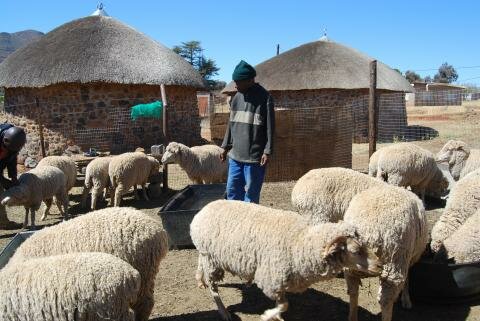
MASERU- Lesotho’s Wool and Mohair farmers are facing immense poverty as a result of the current drought that has hampered the country.The President of the Lesotho Wool and Mohair Growers Association, Mokoinihi Thinyane stated that the current drought has affected them badly because water sources have dried up and animals have nothing to graze as they fend for grass from patched grasslands. Thinyane said the current drought is a sure sign that there would be poor harvests of wool and mohair for the 2015/2016 harvest season.
The President said the whole country has been hard hit by severe drought, which saw some animals dying of hunger and thirst, saying the tall animals such as cows, horses, and donkeys are the most affected. “We generally need fairly good adaptation measures for the dry spells,” he said.
He said there have been reports that tall animals have died but no reports of death for short animals. “Chances are high that we would experience animal diseases because there is no more running water for the animals,” he explained. Thinyane told the Informative newspaper that the goats would be shed in April this year while the sheep would be shed in August; saying the harvest is not promising.
He said in the past harvest season of 2014/15, revenues from sheep contributed a sum of M195 million while goats generated M57 million, making a total of M252 million. “This money contributed significantly to the country’s revenues,” added Thinyane.Asked if there are any diseases reported because of the prevailing drought, Thinyane said there are no such reports. He said there is ongoing vaccination of scab in the country, which is an exercise, conducted annually to protect the animals against this disease.The President indicated that the dipping of animals will not take place because there is no water in most parts of the country.
“Even if the government could supply us with water, it would be impossible to execute the dipping process because some of our tanks are located in the hard to reach areas of the country,” explained Thinyane. He said Lesotho’s already diminished pastures have been exacerbated by the prevailing drought.
Meanwhile, Dr. Relebohile Gerard Mahloane, a state veterinarian at the Department of Livestock Services at the Ministry of Agriculture and Food Security (MAFS) said the current situation has adversely affected the animals. Dr. Mahloane said most animals are lean and weak and therefore prone to diseases, “this is the result of the heat stress and lack of food.”
He explained that there is generally a risk of Anthrax countrywide because animals are concentrated at one place to scour water and grass and therefore chances are high that the disease could be transmitted amongst the animals. According to Dr. Mahloane, animals graze grass together with some bacteria from the soil because the grass is slow and in that process, animals could easily get the bacteria.
He said his Ministry will have a share of the cake from the contingency budget allocated by the government to counter the drought where he told this paper that they would buy some medication if need be. However, the veterinarian stated that there are no reported cases of animals that have died because of drought.
He said there is no cure for ‘weak’ animals than feeding them properly. Lesotho’s pastures are so parched that they look like deserts. As drought intensified and Lesotho’s temperatures recorded as high as 43C, according to Lesotho Meteorological Services, the soil has turned into dust and animals are scouring the baked land for something to eat.
Farmers in the remote highlands of the country are the ones most hard hit by the current drought because they rely for their survival on income from the wool and mohair of their sheep and goats whereas those living in the lowlands have alternative sources of income.

The New Partnership for Africa’s Development (NEPAD) tool for the inclusion of livestock in the Comprehensive Africa’s Agriculture Development Programme (CAADP) Compacts and Investment Plans shows that in 2006, CAADP was enriched by a Companion Document titled ‘Integrating Livestock, Forestry and Fisheries sub sectors into the CAADP,’ which defines priorities for development and areas of investment in these three sectors of agriculture.
It further shows that the African Union – Inter African Bureau for Animal Resources (AU-IBAR) is mandated to support the implementation of the Livestock Component of the CAADP Companion Document at regional and country levels.
The tool says in April 2010, therefore, the AU-IBAR released a ‘Framework for Mainstreaming Livestock in the CAADP Pillars’, which first shows how growth of livestock can contribute to the economic growth, food security and poverty reduction, and then identifies livestock related interventions to promote a broad based development of the sector (AU-IBAR, 2010).
CAADP is an expression of the African Heads of State and Government’s desire to accelerate agriculture-led economic growth in Africa, with the ultimate goal of eliminating poverty and malnutrition across the continent under NEPAD. It is therefore befitting to submit that the current drought in the country and some parts of Southern Africa would have a serious impact on the CAADP’s goal of eliminating poverty through livestock.