


Young couple delves into agriculture
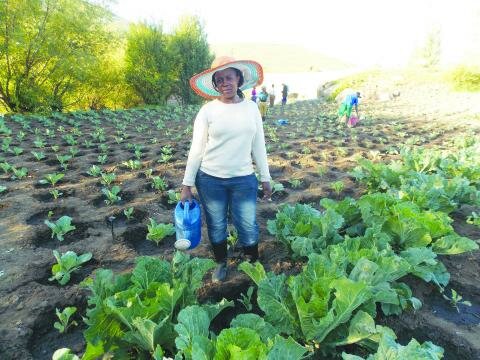
THABA-TSEKA- Newly married couple living in the Lesotho’s 10th district, Thaba-tseka, has set a discernible influence on the lives of jobless youth in the budding township and its surroundings.
“When I first got married to my husband, we were both unemployed and we had to ensure that we had something to put on the table,” explained 26-year-old ‘Maitumeleng Mpanya, busy watering her vegetables using her plastic watering can and tightly holding a digging fork with another hand.
Mpanya said at first she was not wholeheartedly involved in farming enterprise but her supportive husband led her by example to do farming in a sophisticated manner.
She said during one of the good old days, she followed her husband to their rented farm in 2009 close to a water source to see for herself what her husband was actually doing on the farm.
“I thought my husband was doing farming simply because he was unemployed and that farming was just something he could do to relieve his stress.
“When l got to the farm, I discovered that my husband had planted varieties of vegetables that included cabbages, spinach, carrots and others,” explained the young lady.
She said that was the beginning of her attitude change towards agriculture, saying even if her husband would delay going to the farm, she would leave on her to carryon on with the farming activities.
Mpanya indicated that they sell the vegetables to the community in the area and explained that there is life in agriculture only if one is committed.
“I have two children that I send to school and pay almost all their tuition fees with money from agriculture,” she said.
The young lady said the in recent past, Elñino-induced drought that has struck southern Africa including Lesotho did not affect her negatively on a farm because she had a reliable water source adjacent to her farm.
However, she revealed that her vegetables were under severe heat stress and she had to be on her farm to water them on daily basis.
The African Heads of governments held a Summit in Maputo, Mozambique in 2003 to have a roadmap to solve hunger and malnutrition in Africa. The commitment was referred to as Maputo Declaration.
The Maputo Declaration is the affirmation of the African countries to finance agricultural sector with at least 10% of the national budget.
It was during that Summit that the African countries devised the Comprehensive Africa’s Agriculture Development Programme (CAADP) which is Africa’s policy framework for agricultural transformation, wealth creation, food security and nutrition, economic growth and prosperity for all.
CAADP is an African-wide agenda designed to support the transformation of the continent’s agriculture for sustained food security and socio-economic growth.
CAADP has proposed incorporation of youth voices in CAADP processes to recognise them as major stakeholders in the CAADP process and create a platform where their voices can be heard on issues that directly concern them.
Additionally, it was documented that involving the youth in the examination and review of existing policies as well as in determining and evaluating potential policy alternatives will help fight hunger.
CAADP also brings to the fore that guiding the youth in communicating their challenges, ideas, and experiences and to establish a platform to bridge the gap between policy makers and the youth.
It further takes into consideration that incorporating agriculture development and a value chain approach in the education system from the primary level will promote and help develop an interest in agriculture in the youth from a young age.
The Malabo Declaration seeks to ensure proper coordination of existing agricultural and youth programmes run by different stakeholders in order to help the eradication of unemployment amongst youth through agriculture.
World Vision Lesotho has played a major role by providing agricultural equipment such as pipes, herbicides, insecticides and many more. This shows that some stakeholders like World Vision are already playing their role in the existing programmes to help youth in agriculture.
Meanwhile, Minister of Gender, Youth and Sports, Mathibeli Mokhothu has announced that his Ministry has some funds to help youth in various projects including agriculture.
The Minister appealed to all youth to visit his offices with their proposals so that he could help them with funds to start up their various projects.
The Minister has recently provided youth in Thabana Morena Constituency with some agricultural inputs to help them start their projects as another initiative to combat unemployment through agriculture.
The coordinator of CAADP Dr. Augustin Wambo, remains adamant that it would be healthy for Africa to engage youth in agriculture.
He vehemently appealed to African countries that they should attract more youth into agriculture by bringing more incentives that would motivate them to see that they could earn a living out of agriculture.
This paper therefore understands that youth should get rid of the old fashioned mentality that Agriculture is for the uneducated.
Lesotho’s National Strategic Development Plan (NSDP) 2012/13 – 2016/17 indicates that Lesotho’s agricultural production has plummeted tremendously over the years and measures need to be undertaken to revive it and increase food security and its contribution to employment.
NSDP shows that the main strategic objective in this regard is to promote sustainable commercialisation of the sector and diversification of agricultural products by, amongst other things, improving access to finance and the capacity to produce high value products, and developing water harvesting infrastructure and increasing irrigation capacity.
In the light of the above, Lesotho has to implement CAADP since it shows that it will help the country in many ways towards lifting food production.
Lesotho launched CAADP in May 26, 2011 and subsequently signed its Compact in 2013.