


Young farmer survives El Niño-induced drought
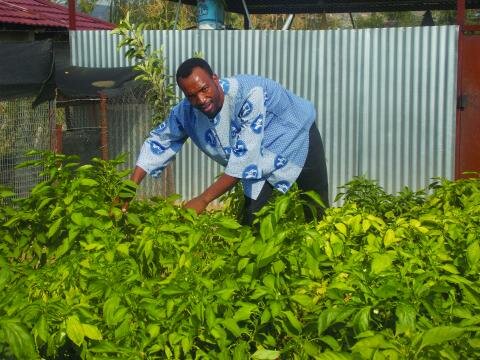
BEREA- As 2015 drew to a close, Lesotho was struck by El Niño -induced drought, a situation that left many farmers without even one suitable plot of land to plant vegetables.
Effects of the drought are now being felt strongly, four months into 2016. The failed rains had spelt economic catastrophe for most farmers last year as they completely failed to plough. But not for Rasekopane Rampooane, a young but experienced farmer living just outside Maseru, the capital city. He did not succumb to the phenomenon.
Rampooane is one of the few farmers who escaped the ravaging drought to produce a variety of vegetables during the drought – thanks to the farming knowledge he had acquired earlier on. He once worked in South African farms where he learnt that experienced farmers do not usually remove all the vegetation over the land after harvesting their produce.
Like what most farmers did, albeit in vain, Rampooane did not wait for the abundant rains but continued with the plantation of crops on his small farm using moisture and manure retention methods to germinate crops.
“Farmers in South Africa usually till the remnants of the previous harvest’s produce under the soil. This adds nutrients to the soil,” he says knowledgeably.
While working there, Rampooane did not take time and quickly emulated this simple technology and applied it back home on his farm through a different process but with the same purpose. As a result, the young farmer has been able to make ends meet at his small plot and the results are there for all to see.
Rampooane has also developed his own unique cultivation method. As a principle, he says, he removes all plant stems on the farm and cuts those into pieces before placing them into furrows especially made for the purpose.
“On every cultivated plot, I make furrows and place the plants that I have cut into pieces and bury them underneath. Consequently, I dig plantation lines on the soil before sowing the seeds,” he explained.
This experienced farmer said in no time, his seeds speedily germinate regardless of drought conditions.
“I therefore use very little water for my plants,” he says.
Rampooane indicated that the plants while under the soil rot and become manure and at the same time, able to trap water.
During the night in winter, he explains, the rotten plants generate heat for the crops and he does not need to use a lot of water for irrigating the plants. Just a minor sprinkle will do. The plants can take up to almost a week without being watered because the method that he employs conserves moisture.
“In winter, most vegetables wilt due to coldness but my crops become green throughout the year. I apply this simple technology to make my vegetables a success even in hard times.
“This is how I escaped the effects of drought late last year and earlier this year,” he boasts proudly.
And because of this there has been an influx of street vendors from Maseru market coming to buy fresh vegetables at his farm.
“I love agriculture and it also loves me back. Most youth in the area usually come to my farm to try and learn how I have managed to produce such healthy vegetables throughout the year, even in hard times.”
“I had planted a variety of vegetables including spinach which is able to withstand severe drought. I have also managed to make a considerable profit out of selling vegetables,” he told the Informative.
Asked what inspired him to become a farmer, Rampooane said in 2010 when he got his own site, he realised that there was no one who sold vegetables in his area.
“I took advantage of that scarcity of vegetables and fully became engaged in vegetable production,” he explained.
Despite being a vegetable producer, Rampooane has also kept some ‘koekoek’ chickens in his farm as source of food for his family and also sells their eggs to earn extra revenue.
He reiterated that he has no formal training in agriculture in all its forms.
Further asked about the challenges that he met in agriculture, he indicated that insects and birds were the major invaders of his crops but with the help of his wife who is enthusiastic about agriculture, bought him some insecticides that help to protect the crops.
“I spent most all my time at the farm because it is source of living for my family,” he explained. “I have no other means of survival other than vegetable production.”
Rampooane is also of the view that the first two of the United Nations’ 17 Sustainable Development Goals (SDGs) by 2030 - namely; ‘No Poverty’ and ‘Zero Hunger ’ - could be met if youth could be equipped with necessary skills and adequate resources to venture into different agricultural projects.
According to the Africa Status Report 2015 - Youth in Agriculture in Sub-Saharan Africa, youth participation all along the value chain is vital to the growth of the agriculture-based economies of most African countries – from agricultural research and development, to food production, storage and handling, to agro- processing, through to marketing and distribution in local, regional and international food markets.
Research has shown that three quarters of the population in the Southern African Development Community (SADC) region are below the age of 35 and most of them are either children or the youth.
According to Rampooane this huge population of young people is actually a window of opportunity for the region, and Lesotho in particular, to capitalise on so that rapid socio-economic growth and development could be realised through agriculture.
Meanwhile, Dr. Augustin Wambo, the coordinator of the Comprehensive Africa’s Agriculture Development Programme (CAADP), reiterates that incentives should be brought to the fore to motivate youth that they could earn a living out of agriculture.